|
STAINED GLASS When Knox, Brantford and Mount Pleasant
churches were amalgamated in 2012, five stained-glass windows created by
artist Douglas Hughes were transferred and installed on the walls of the Mount
Pleasant sanctuary. The theme of the windows is THE KINGDOM OF HEAVEN. |
||
|
|
|
|
|
THE
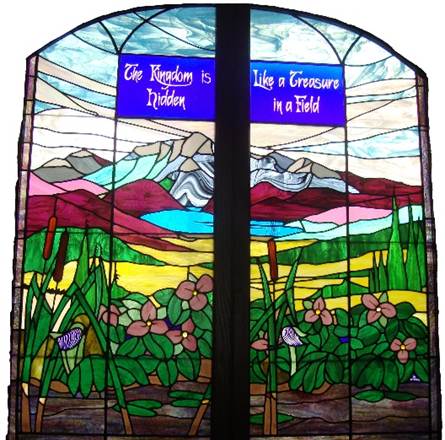
KINGDOM IS LIKE A TREASURE HIDDEN IN A FIELD |
||
|
Donated by The
Hughes Family in 1991. |
The majesty of British Columbia was the motivating force that shaped
this window. The concept of uniting the beauty of our Earth with that of the
Kingdom was an easy second step. The Kingdom is there for those who choose to
look. The actual scene is not any particular place.
The mountains are B.C., but the trilliums and rushes could be Ontario as
well. The trilliums with their three petals were chosen to represent the holy
trinity and if you look closely, you will see a little treasure hidden on one
of the rush stems. Part of the verse appears in each
side of the window. You may interpret the verse by reading horizontally or
you may read each section separately. |
|
|
||
|
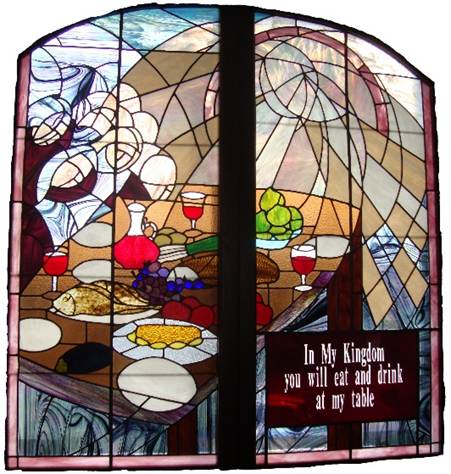
This window shows what we will meet when our time on Earth has ended,
and we have reached "The Table" in the Kingdom. The stylized
figures are not representative of male or female, young or old, or race or
creed. Some of these forms are represented by only a curved line suggesting
the continuous procession of people entering the Kingdom. A mother-of-pearl,
streaky-black glass used around the figures represents that nebulous area
between Earth and Heaven. The window lightens from bottom to top, from Earth
to Heaven. The window shows the "presence" of God rather than a
definite form. Heaven is all encompassing; it is a place of protection,
gathering, and nurturing. |
Donated by. Bob Brown in loving memory of
his wife Jean Brown and by Bessie Brown and Ena Wright in loving memory of
their mother Elizabeth
Adams, and their husbands George Brown and Harry Wright in 1992. |
|
|
THE
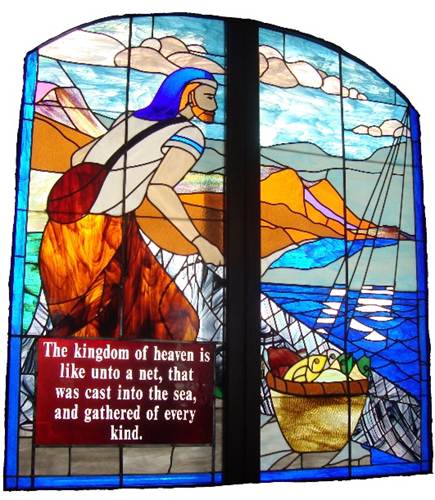
KINGDOM OF HEAVEN IS LIKE UNTO A NET, THAT
WILL CAST INTO THE SEA AND GATHER OF EVERY KIND |
||
|
Donated in loving
memory of Alexander and Mary Stewart, Arthur and Mary Lowe, Archie and Alice Campbell and John and Mary Douglas in 1996. |
Except for the blue head scarf, the fisherman's clothing suggests a
common man. His beard and clothing are similar to
the landscape, suggesting a connection between the figure and the Earth. The
fish are varied. According to St. Matthew, when the net was full, it was
drawn to shore and the good fish gathered into vessels, but the bad fish were
cast away. The rolling landscape gives a sense of calmness. The sunlight
glitters on the waves, perhaps a benediction to those good fish being
gathered in. The blue sky suggests all is well; however, a vague area of
greyness appears over the far hills. |
|
|
THE
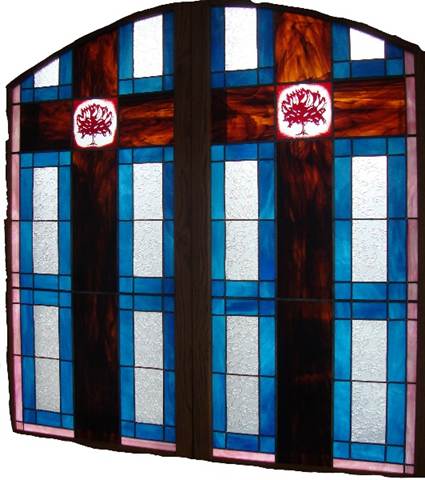
BURNING BUSH |
||
|
As Knox Presbyterian Church had four front windows, this final one
made the front facade of the church complete, a gift from the congregation.
The burning bush depicted in the window is a symbol of the Presbyterian
Church. The burning bush is an object described in the Book of Exodus
(3:1-22). It was located on Mount Horeb, where God appointed Moses to lead
the Israelites out of Egypt into Canaan. The inscription Nee Tamen Consumbatur refers to the bush that burns but
is not consumed, as will be the church that will last forever. |
Donated by the congregation of Knox
Presbyterian Church, Brantford. |
|
|
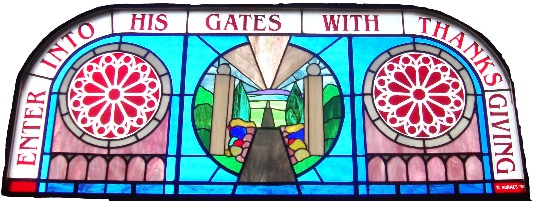
ENTER
INTO HIS GATES WITH THANKSGIVING |
||
|
Donated by Nan McDonald in
loving memory. Bella and Charles Mars and Norma Howell in 1998. |
The centre section of this window shows the
gates of the Kingdom of Heaven. The two outside sections are symbolic of
gothic rose windows. The twelve spokes in each wheel represent the creative
order embodied in numbers, the twelve apostles. The universe is manifested in
the concentric layers which are symbols of the sun, moon, planets and stars.
This window is in Saint Andrew's Hall. |
|
|
The church also features
several memorial stained-glass windows. The first, depicting the Good
Samaritan was erected in 1904 in memory of George Bryce, the president of the
first Board of Managers. The second was erected in memory of Harvey McLean, a
faithful adherent whose wife, Vallera, was the church organist and choir
leader for many years. |
||
|
|
||
|
|
|
|